 Black Deal 50% off the first year with annual billing – only until December 31, 2026.

Best accounting software used in Germany for freelancers and microbusinesses
Choosing the right accounting software used in Germany means navigating a comparatively complex and detailed set of tax and accounting rules. GoBD archiving, ELSTER tax submissions, structured e-invoicing in ZUGFeRD or XRechnung format, and the EÜR income-expense report for eligible freelancers each carry real legal weight. Pick the wrong software and you are not just inconvenienced, you are exposed to audit risk and unnecessary rework. This guide maps the main tools used in Germany, explains what each one actually covers, and helps you find the right fit for your situation, whether you are a German-speaking freelancer or an international entrepreneur who just set up in Berlin.
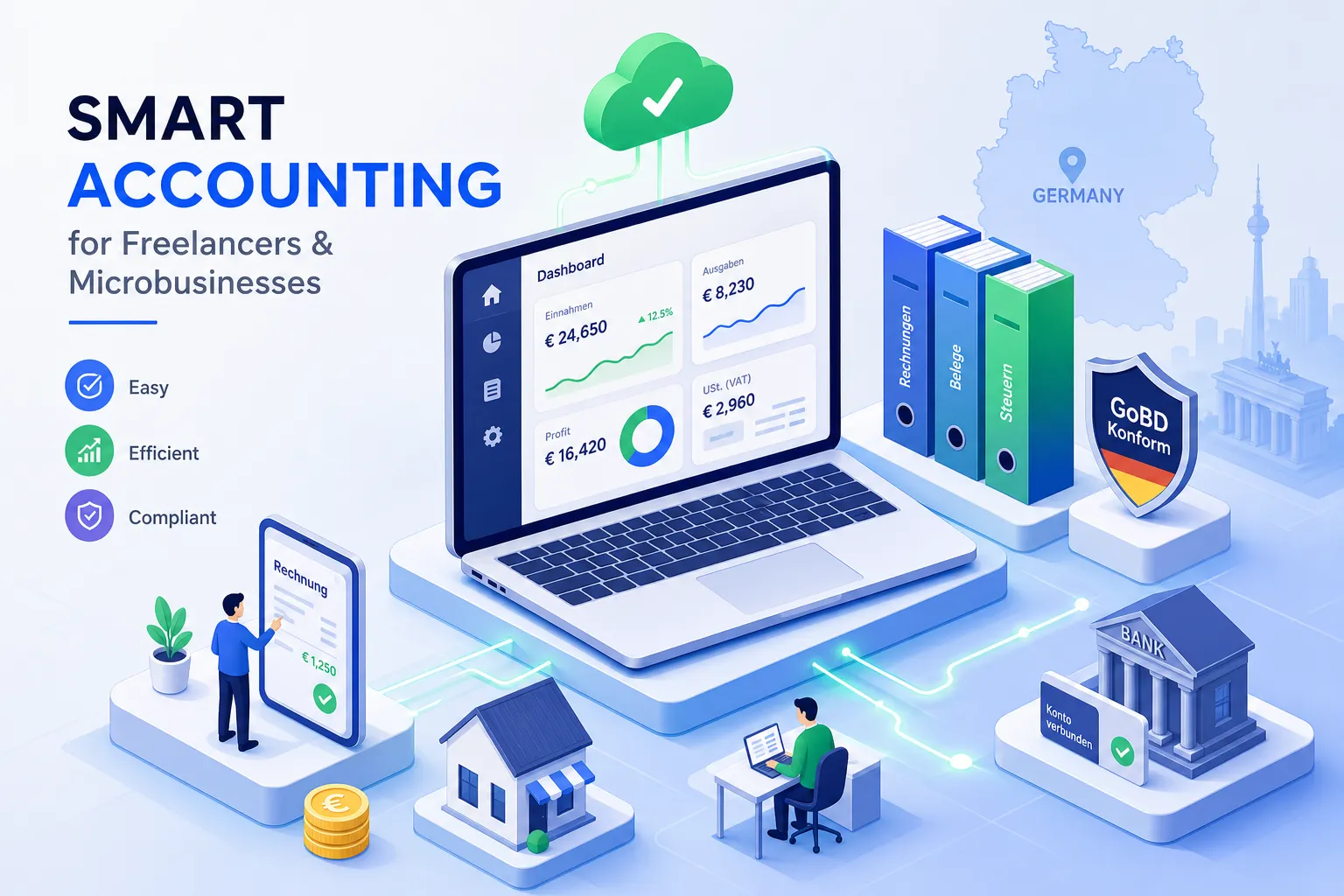
What German law actually requires from your accounting software
GoBD compliance: the baseline you cannot ignore
GoBD stands for the German principles of proper accounting-related systems. In plain terms, your software must store records in a tamper-proof way, maintain a full audit trail of every change, and retain documents for ten years. It is not a certification badge that vendors apply for; it is a set of documented controls that must be built into the software and maintained correctly on your side. A vendor claiming “GoBD-compliant” should be able to provide a compliance declaration, a control matrix mapping each requirement to a specific feature, and a sample audit trail. If they cannot, look elsewhere.
Many cloud invoicing tools fall short here. They generate invoices and track expenses, but they do not enforce immutability, link receipts to individual postings, or support tax-audit data exports. Common gaps include missing correction-posting logs and the absence of a structured GDPdU/GoBD data export for the Finanzamt. Before choosing any platform, confirm that it explicitly covers immutable storage, correction postings with audit history, receipt archiving, and structured data export.
ELSTER and e-invoicing: two compliance requirements you cannot skip in 2026
ELSTER is Germany’s official tax submission portal. Software that supports ELSTER integration lets you submit your VAT advance returns (Umsatzsteuer-Voranmeldung) and your EÜR (Einnahmenüberschussrechnung) directly to the tax office from within the application, authenticated by your ELSTER certificate. Some tools only “prepare” these forms and still require you to type the numbers into Mein ELSTER manually. That is a meaningful distinction, check whether the tool actually transmits the filing or merely formats it.
Since 2025, businesses operating in Germany have faced phased B2B e-invoicing obligations. Under the applicable German legislation, domestic B2B invoices must be issued in a structured electronic format; ZUGFeRD embeds structured XML data inside a standard PDF, while XRechnung is a pure XML format widely used for public-sector billing. If you invoice other German businesses or public authorities, your accounting software needs to support the relevant format. This requirement alone removes a significant number of generic European cloud tools from the shortlist. Check current BMF guidance or your tax adviser to confirm which obligations apply to your specific business situation.
Accounting software used in Germany: a quick map of the market
Who dominates and why
DATEV is widely reported to hold close to half of the German accounting software market, though that figure likely understates its footprint because many businesses access it indirectly through their Steuerberater rather than as direct users. DATEV operates as an accountant-led ecosystem rather than a self-service product. Lexware Office (formerly lexoffice) and sevDesk are the two main cloud platforms that freelancers and small businesses actually operate themselves. FastBill and Qonto sit at the edges: FastBill is invoicing-first, and Qonto is a business banking tool that connects to accounting software rather than replacing it.
Comparison table: core features at a glance
| Tool | GoBD | ELSTER | ZUGFeRD / XRechnung | Multilingual | EÜR | Starting price (approx.) |
|---|---|---|---|---|---|---|
| DATEV | Yes | Yes | Yes | Not documented | Yes | ~€11/mo (+ adviser fees), approx., as of 2026, check with the provider |
| Lexware Office | Yes | Yes | Yes | Not documented | Yes | €7.90–€32.90/mo (as of September 2026, net) |
| sevDesk | Yes | Yes | Yes | See provider | Yes | €9.90–€30.90/mo (as of September 2026, net) |
| FastBill | Yes | See provider | See provider | Not documented | See provider | ~€10–€50/mo, approx., as of 2026, check with the provider |
| Qonto | See provider (business banking; connects to accounting software) | Not documented | Not documented | See provider | Not documented | ~€9–€49/mo, approx., as of 2026, check with the provider |
| KontoVexa | Yes | Yes (Business and Pro plans) | Yes (from the Start plan) | Yes (9 languages) | Yes (Business and Pro plans) | €9.90/mo (Start, net); 30-day free trial |
Qonto and FastBill serve as supplementary tools rather than full bookkeeping replacements. Qonto handles business banking and connects to accounting platforms; FastBill focuses on invoicing and expense tracking, though its e-invoicing and VAT reporting coverage is plan-dependent, verify the current feature set before committing. KontoVexa’s most distinctive characteristic in this comparison is multilingual support: it covers the German compliance stack (ELSTER filing from the Business plan) while running in nine languages, including English, Turkish, Arabic, and Polish. Its simplified mode surfaces only the features relevant to your current setup, with everything else accessible when you need it. Prices listed are approximate; always confirm current pricing directly with each vendor, as rates and promotions change regularly.
Best picks for freelancers and microbusinesses
Lexware Office and sevDesk: the established German-language options
Both platforms are GoBD-compliant, support direct ELSTER submission, generate ZUGFeRD and XRechnung invoices, and offer DATEV export for tax advisers. Lexware Office suits service freelancers with straightforward invoicing and EÜR needs; its L plan (approximately €21.90/month, verify current pricing on the vendor site) covers VAT returns and profit reporting. sevDesk makes more sense when your setup involves recurring invoices, more complex VAT cases, or a higher transaction volume. Its Buchhaltung plan (approximately €22.90–€25.90/month, depending on the billing period) adds bank connections, receipt capture, and VAT workflows. According to the providers’ published information (as of October 2026), both platforms are primarily German-language, which can be a barrier for anyone not comfortable working entirely in German. Note that sevDesk offers some English-language support; check the vendor site for the current scope.
KontoVexa: a strong option for multilingual and migrant freelancers
For international freelancers and migrants working in Germany, KontoVexa is worth evaluating specifically because of its multilingual interface, available in nine languages, including English, Turkish, Arabic, and Polish, combined with coverage of the German compliance stack. ZUGFeRD and XRechnung e-invoicing and GoBD-compliant document archiving are included from the Start plan; direct ELSTER submission and automated EÜR generation are included from the Business plan. The simplified mode removes features you do not need yet, keeping the experience clean without locking anything away permanently. A 30-day free trial without a credit card and a Start plan from €9.90/month (net) reduce the initial cost barrier for new freelancers; the Business plan with ELSTER and EÜR costs €22.90/month (net).
When to look at DATEV (and when not to)
DATEV is not a tool you set up yourself on a Sunday afternoon. It works best when your Steuerberater already operates within the DATEV ecosystem and requires direct data access. For a solo freelancer without an existing accountant relationship, starting with DATEV often adds cost and complexity without a compliance advantage that matters for this profile over Lexware Office, sevDesk, or KontoVexa.
Choosing accounting software in Germany: four questions that narrow the shortlist
Four questions narrow the shortlist faster than any pricing comparison. First, does the tool actually transmit your ELSTER filings, or does it only prepare them for manual entry? Second, does your tax adviser require a DATEV export, and does the software provide it? Third, do you need a multilingual interface, or are you fully comfortable working in German? Fourth, what is your monthly volume of invoices and bank transactions? That last question directly affects which pricing tier makes sense for your situation.
Pricing reality: what you actually pay for a compliant setup
A fully compliant freelancer setup covering GoBD archiving, ELSTER submission, bank sync, and EÜR generation typically costs between €20 and €35 per month with sevDesk or Lexware Office at their mid-tier plans. Annual billing saves roughly 10 to 20% across most platforms, so factor that in from the start rather than switching later. With KontoVexa, the Business plan with ELSTER submission, bank statement import, and EÜR generation costs €22.90 per month (net); the Start plan at €9.90 per month and the 30-day free trial reduce the entry cost for new freelancers who are not yet generating consistent revenue. Be cautious with add-ons: payroll, multi-currency, and inventory modules push costs up quickly, so verify whether you actually need them before upgrading.
Three real-world setups to find your match
Setup 1: German-speaking freelance designer, simple EÜR, no Steuerberater
This freelancer needs invoice creation, receipt upload, EÜR at year-end, and VAT advance returns via ELSTER, nothing more. Lexware Office M or L is a straightforward fit: both handle invoicing and document capture, and, depending on the plan, EÜR and VAT return submission are included; check the current plan contents with the provider. DATEV export, payroll, and inventory features add clutter and cost without any compliance benefit for this profile.
Setup 2: International freelancer in Berlin, prefers working in English
This freelancer needs the same full compliance stack as any other German-based business, but most mainstream platforms operate primarily in German. Working in a language you do not fully control leads to mis-categorized expenses, incorrect VAT codes, and filing errors that surface at the worst possible time.
KontoVexa addresses this directly. It delivers ZUGFeRD and XRechnung e-invoicing and GoBD-compliant archiving from the Start plan, and direct ELSTER submission and automated EÜR generation from the Business plan, within an interface available in English, Turkish, Arabic, Polish, and five other languages. The simplified mode shows only what is relevant for a freelancer’s setup, so the experience stays clean from day one without requiring you to translate German accounting terminology yourself; the official German tax terms stay visible.
Setup 3: Small e-commerce business with a Steuerberater and five employees
This business needs DATEV export, recurring invoice management, bank reconciliation, and a clean handoff to its tax adviser. Both sevDesk Buchhaltung Pro and Lexware Office XL are solid fits here, particularly because they integrate with the adviser’s DATEV workflow. One important note on payroll: according to the provider’s published information (as of October 2026), sevDesk does not offer full native payroll processing. Lexware offers payroll functionality via an add-on, and DATEV remains the standard for comprehensive payroll managed by accountants, covering Lohnsteuer filings, ELStAM, and year-end certificates. Verify current add-on availability and pricing directly with each vendor.
The right tool clears a legal bar first, then competes on price and features
Every piece of accounting software in Germany must meet a specific legal baseline before features or pricing become relevant: GoBD compliance, ELSTER submission capability, structured e-invoicing support, and EÜR generation for eligible businesses. Tools that miss any one of these create real legal exposure for the freelancer or business owner relying on them.
For German-speaking freelancers, Lexware Office and sevDesk are the proven mainstream options with solid compliance records. For international entrepreneurs and migrant freelancers who need to work in a language other than German, KontoVexa is a purpose-built option that covers the German compliance stack, ELSTER submission and EÜR generation (from the Business plan), ZUGFeRD and XRechnung e-invoicing, and GoBD archiving, while running in nine languages and offering a 30-day free trial and a Start plan from €9.90/month.
KontoVexa’s 30-day free trial, without a credit card, lets you test the features of your chosen plan, such as ZUGFeRD e-invoicing and, in the Business plan, ELSTER submission and EÜR generation, before committing to a paid plan. It is a practical way to confirm that the compliance features work for your setup before spending anything.
More about the matching KontoVexa feature: Self-employed
Step by step in the KontoVexa user manual: Software for microbusinesses
As of: October 2026. General information, not tax advice.