 Black Deal 50% off the first year with annual billing – only until December 31, 2026.

Recurring Invoices: How to Set Up and Automate Invoice Series

Recurring invoices are invoices you send to the same customer on a fixed schedule for the same or nearly the same services: the monthly maintenance fee, the retainer, the licence, the rent for a workspace. You create the template once, set the interval, start date and term, and every new invoice is generated from it with its own invoice number, the current date and the correct period of supply. Here you will learn what applies legally, how to choose the billing cycle and where you should still take a look despite the automation.
In brief
- Recurring invoices are worthwhile for everything you bill regularly on the same terms, such as flat fees, subscriptions, maintenance, support or rentals.
- Every single invoice in the series needs all mandatory details under § 14 UStG, above all its own sequential number and the specific period of supply.
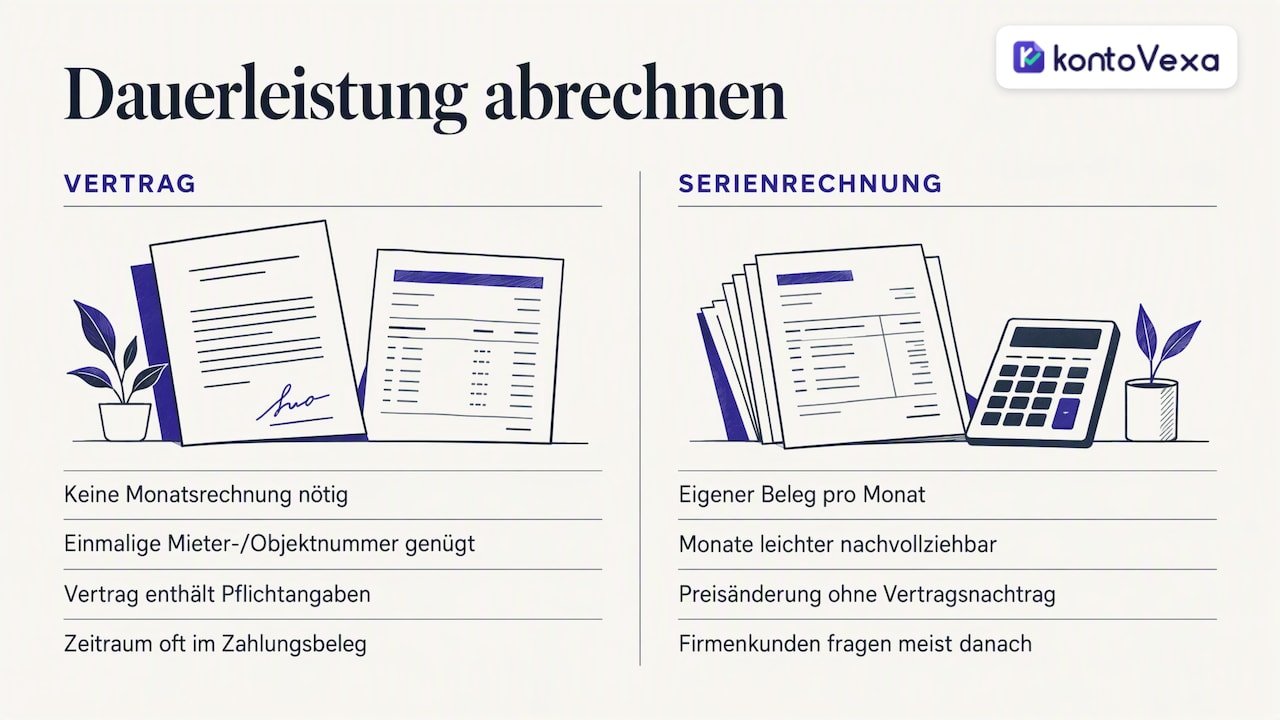
- For ongoing services, a contract containing all mandatory details can also serve as an invoice; in that case a one-off contract or property number is sufficient.
- Automate creation and sending, but check price changes, tax rates, recipient details and open items at fixed intervals.
- Multilingual invoices are possible as long as the mandatory details remain complete and unambiguous.
Table of contents
- What recurring invoices are and what they are suited for
- Choosing the right billing cycle
- Mandatory details: what must appear on every invoice in the series
- Step by step: setting up an invoice series
- Send automatically, check selectively
- Changing, pausing or ending a series
- Recurring invoices as an E-Rechnung
- Multilingual invoices for international customers
- Our view on recurring invoices
- Invoices and taxes in one tool
- Frequently asked questions about recurring invoices
- Sources
What recurring invoices are and what they are suited for
A recurring invoice, often also called a series invoice, subscription invoice or standing invoice, is not a separate type of invoice under VAT law. It is a way of working: you take one invoice as a template and generate new, independent invoices from it at fixed intervals. For the Finanzamt (local tax office), each of them is a perfectly normal invoice with all the obligations that come with it.
The benefit lies in everyday work. If you look after ten customers on a monthly flat fee, you would otherwise write the same invoice ten times a month, copy line items, adjust the date and period, and at some point forget one. With a series, the retyping disappears, and the human error factor shrinks to the places where something actually changes.
Services with a fixed rhythm and largely identical data are well suited:
| Service | Typical example | Usual cycle |
|---|---|---|
| Support flat fee | Web designer maintains client websites | monthly |
| Retainer | Copywriter or consultant with a fixed quota of hours | monthly |
| Maintenance and support | IT service provider looks after computers and servers | monthly or quarterly |
| Software and licences | Your own tool or plugin as a subscription | monthly or annually |
| Rentals | Coworking desk, storage space, equipment | monthly |
| Courses and memberships | Yoga studio, music lessons, coaching programme | monthly or quarterly |
| Annual services | Hosting, domain management, annual maintenance | annually |
Less suitable are projects where scope and amount change every time, such as billing by hours actually worked. Even there a series can help if you use it as a template with fixed customer data and texts and only adjust quantity and amount before sending. A clear separation helps: series invoice for what stays the same, project invoice for what changes.
If you want to understand in more depth how regular payments work on the payment side, i.e. direct debit, card charges and subscription models, you will find a concise overview of recurring payments in practice. Invoice and payment are two sides of the same coin: the invoice documents the claim, the payment settles it.
Choosing the right billing cycle
Common intervals are weekly, monthly, quarterly, half-yearly and annually. Which one fits depends on three questions: How do you deliver the service, what does your customer expect, and how much liquidity do you need?
| Interval | Works well for | Advantage for you | What to watch out for |
|---|---|---|---|
| weekly | Temporary help, short intensive assignments | fast incoming payments | a lot of admin, many documents |
| monthly | Flat fees, retainers, rentals, subscriptions | predictable cash flow, customers know the rhythm | standard for most self-employed people |
| quarterly | Maintenance contracts, support for corporate clients | fewer invoices, larger amounts | longer pre-financing on your part |
| half-yearly | Upkeep contracts, seasonal services | little effort | customer pays less often, you wait longer |
| annually | Licences, hosting, annual memberships | one transaction a year, often paid in advance | plan cancellations and price adjustments in good time |
Two practical rules have proven their worth. First: bill in step with the service. If you provide support monthly, bill monthly; then the period of supply and the invoice match neatly. Second: think about your own Umsatzsteuer (VAT). If you issue invoices in advance at the start of the month and pay VAT on an accrual basis, the VAT may become due before the money has arrived. We explain how the advance return works and which deadlines apply in our guide to the Umsatzsteuer-Voranmeldung (UStVA, periodic advance VAT return). Whether Soll-Versteuerung (accrual-basis VAT) or Ist-Versteuerung (cash-basis VAT) applies to you is best clarified with your tax advisor before you invoice large annual amounts in advance.
Mandatory details: what must appear on every invoice in the series
Automation does not change the rules. Under § 14 UStG, every invoice must contain the statutory mandatory details. For a series invoice, this specifically means:
- Name and address of you as the supplying business and of your customer. If the customer's address changes, the series must reflect this.
- Steuernummer (tax number) or USt-IdNr. (intra-EU VAT identification number) of yours.
- Date of issue, i.e. the date on which the respective invoice is actually generated.
- Sequential invoice number that is unique. Every invoice in the series gets a new number; repeating the number from the previous month is an error.
- Quantity and type of service, described clearly, for example “Website maintenance as per contract of 15.01.”.
- Date or period of supply, which for series is practically always a period such as “Period of supply 01.10. to 31.10.”. This is where most errors occur when a template does not automatically roll the period forward.
- Net amount, tax rate and tax amount, or the note on a tax exemption, for example if you use the Kleinunternehmerregelung (small-business VAT scheme).
You will find a detailed explanation of each detail with examples in our guide Writing invoices as a self-employed person. For series in particular: placeholders for date, number and period must update automatically on every invoice. Otherwise a static text such as “October 2026” in the service description becomes a problem in November.
Special case of ongoing services: the contract as an invoice
For rent, leases or maintenance contracts, often no monthly invoice is written at all. The IHK Bremen (Chamber of Commerce) explains that for such ongoing services the regular payment can be based on a contract. For your customer to be able to deduct the input VAT, this contract must then contain all mandatory details of an invoice.
According to the same source, instead of a sequential number for each payment, a one-off number such as a tenant or property number is sufficient. In practice, the period is often supplemented by the payment records, for example the bank statement with the reference “Rent October”.
For many self-employed people, a genuine series invoice is still the better choice. It is easier for both sides to follow, each month has its own document, and you document price changes without a contract amendment. Corporate clients' accounting departments usually ask for one invoice per period anyway.
Step by step: setting up an invoice series
This is how to proceed, whether you work with invoicing software or maintain a template:
- Check the contract or agreement. What exactly has been agreed: amount, scope of services, term, notice period, payment terms, price adjustment? These points determine the series.
- Enter complete customer data. Company name, address, contact person, email for invoices, and for corporate clients also the purchase order number or cost centre if they ask for it.
- Create the template. Enter line items, unit prices, tax rate and service description. Use automatic fields for the date, invoice number and period of supply.
- Set the interval and start. For example monthly on the 1st, first invoice on 1 November, period of supply always the current month.
- Define the end. Open-ended, after a certain number of invoices or until a date. For fixed-term contracts, enter the end date right away.
- State payment terms and payment method. Bank details, deadline and, if applicable, a note on direct debit with mandate reference.
- Choose the delivery method. As a draft for approval, automatically by email or in the structured e-invoice format.
- Check the first invoice. Before the first run, generate a preview and check number, period, amount and recipient.
An example: a graphic designer supports a trade business for €450 net per month. She sets up a series that, on the first of every month, generates an invoice with “Graphic design support, period of supply 01.11. to 30.11.”, 19 % VAT and 14 days' payment terms. After that, her task is limited to a quick look at the list of open items.
Send automatically, check selectively
Fully automatic sending saves the most time but requires a fixed review routine. A mix has proven effective: automatic creation, automatic sending for stable series, and drafts for series where something changes more often.
Check at fixed intervals, for example once a month before the invoice run:
- Prices and contract changes: Does a new amount, an additional service or a discount apply from next month?
- Tax rates and tax status: Has your status changed, for example because you no longer use the Kleinunternehmerregelung? Then all series must be adjusted.
- Recipient details: New address, new invoice email, new contact person, change of company name.
- Terms and cancellations: If a contract ends, the series must be stopped before the next invoice goes out.
- Open items: If a customer has not paid for two periods, the series should not simply keep running without comment.
- Delivery: If emails bounce or invoices end up in spam, you often only notice because payments are missing.
Filing is just as important. Every automatically generated invoice is an accounting voucher and must be archived in an unalterable form, just like any other outgoing invoice. Software with audit-proof archiving takes care of this for you; with templates in a word processor and email, you have to see to it yourself.
Changing, pausing or ending a series
A series lives with the contract. Three situations come up regularly.
The price or service changes
Change the template as of the effective date, not retroactively. Invoices already sent remain as they are. A short note on the first invoice with the new price, such as “Adjustment as per agreement of 12.09.”, saves queries from your customer's accounting department.
An invoice was wrong
If an incorrect invoice has already been sent, you do not simply delete it. The usual approach is a Stornorechnung or Rechnungskorrektur (cancellation / correction invoice) that refers to the original invoice number, followed by a new, correct invoice. This keeps your number sequence complete and traceable. Your tax advisor can help with questions about the VAT treatment of a correction.
The customer does not pay or cancels
In the event of late payment, pause the series and resolve the matter personally: reminder, dunning notice and, if in doubt, a conversation about further cooperation. If the series keeps running, receivables pile up that you will later have to follow up individually. In the event of cancellation, enter the end of the contract as the end date of the series and check that the last invoice covers the correct, possibly pro-rated, period. If a receivable is ultimately lost, talk to your tax advisor, as this can have consequences for your VAT.
Recurring invoices as an E-Rechnung
Since the reform of VAT law, § 14 UStG distinguishes between the electronic invoice in a structured format and other invoices such as PDF or paper. For invoices between businesses in Germany, the E-Rechnung (e-invoice) is gradually becoming mandatory, with transitional rules depending on turnover and timing.
For series, this is good news. Structured formats such as XRechnung (German e-invoice format) and ZUGFeRD (hybrid e-invoice format) are ideal for automated generation, because all fields come from the customer data and template anyway. Your customer can read them in by machine, which reduces queries and typing errors on both sides. Our E-Rechnung obligation calculator shows when the obligation applies to you, and the guide to the E-Rechnung obligation explains the background.
Multilingual invoices for international customers
Many self-employed people in Germany work for customers abroad or for companies whose accounting is done in English. An invoice in another language is possible. What matters is that the mandatory details remain complete and unambiguous, regardless of the language they are in.
What you should look out for with multilingual series:
- One template per language and customer. Do not mix German and English at random; instead, decide which customer receives which language.
- Date and number formats: 01.11.2026 and 1.200,00 € look right in German, but a different format may be easier to understand for English-speaking recipients. The important thing is that amounts can be read unambiguously.
- Translate tax notes correctly: Notes on tax exemptions or on reverse charge for foreign customers must be accurate in substance. If in doubt, have your tax advisor confirm the wording.
- Keep the service description understandable: A clear, short description in the customer's language speeds up approval in their accounting department.
- Keep an eye on your own bookkeeping: The invoice goes out in a foreign language, but the posting and the UStVA still take place in Germany. Software in which you yourself work in your preferred language makes both easier.
Our view on recurring invoices
We see the same pattern again and again among self-employed people: the work itself goes well, but the invoices go out too late. Not out of carelessness, but because writing the same invoice at the end of the month gets lost between client appointments. Every week of delay is money missing from your account.
That is why we are big believers in standardising everything that stays the same and focusing attention on the exceptions. Maintaining customer data properly once, creating templates, keeping an eye on deadlines: this is not bureaucracy, but the foundation for your UStVA and annual accounts to work later without any searching.
We built KontoVexa so that invoices, expenses, documents and taxes come together in one place, in an interface that adapts to your business, and in the language you work best in. When your invoices are created in the same place from which your advance return is sent via ELSTER (official e-filing portal), a large part of the work that is lost between programs today disappears.
Paulo
Invoices and taxes in one tool
If you regularly bill the same customers, you need one thing above all: well-maintained customer data, clean templates and an overview of deadlines. With KontoVexa you create invoices for self-employed people and e-invoices in ZUGFeRD or XRechnung format, manage customers and suppliers, archive documents in a legally compliant way and receive deadline reminders. You submit the UStVA, the EÜR (cash-basis income/expense statement) and the annual return directly via ELSTER, and, if you wish, in your preferred language.
You can try KontoVexa free of charge for 30 days, without a credit card. After that, you choose a plan: Start for €99 per year or €9.90 per month, Business for €199 per year or €22.90 per month, Pro for €299 per year or €32.90 per month. You will find all the details on our pricing overview.
Frequently asked questions about recurring invoices
Does every recurring invoice need a new invoice number?
Yes. Every invoice in a series is an independent invoice and, under § 14 UStG, needs a sequential, unique number. The only exception is when a contract for an ongoing service itself serves as the invoice: then a one-off number such as a tenant or property number is sufficient.
May I issue recurring invoices in advance?
Yes, you can issue an invoice at the beginning of the period of supply if that has been agreed. State clearly the period to which the invoice applies. Note that under Soll-Versteuerung, this can cause the VAT to appear early in your advance return.
What do I do if the price changes during the series?
Adjust the template as of the date from which the new price applies, and leave invoices already sent unchanged. A short note referring to the agreement on the first invoice with the new price prevents queries.
Does a series invoice have to be sent as an E-Rechnung?
That depends on whether your customer is a business in Germany and which transitional rules apply to you. Structured formats such as XRechnung or ZUGFeRD are particularly well suited for series because they can be generated fully automatically. Our E-Rechnung obligation calculator shows you from when you are obliged.
Sources
Recommendations
This article was machine-translated from German. Only the German version is authoritative.