 Black Deal 50% off the first year with annual billing – only until December 31, 2026.

How to Prepare Your EÜR: Guide with Example for the Self-Employed

For your Einnahmenüberschussrechnung (EÜR, cash-basis income/expense statement), you subtract from all Betriebseinnahmen (business income) of a year the Betriebsausgaben (deductible business expenses) that were actually paid in the same year. You then adjust the result for depreciation, private shares as well as withdrawals and contributions. You enter the resulting profit in the Anlage EÜR (official EÜR form) and send it electronically via ELSTER (official e-filing portal) to your Finanzamt (local tax office). Below we show every step, explain the supporting documents and work through an example for a freelance professional, from the first invoice to the profit.
In brief
- Who may use it? Freiberufler (independent professionals) always; Gewerbetreibende (traders) as long as they are not required to keep books and do not keep books voluntarily.
- How is it calculated? Business income minus business expenses, each in the year in which the money flows (Zufluss-Abfluss-Prinzip, cash principle).
- What do you need? Outgoing and incoming invoices, bank statements, cash receipts, travel and entertainment records, neatly sorted.
- How do you file? The Anlage EÜR is sent to the Finanzamt electronically and authenticated via ELSTER, a separate one for each Betrieb (business unit).
- What saves time? If you record your documents continuously throughout the year, your EÜR is almost finished at year-end.
Table of contents
- What the EÜR is and why it has that name
- Who may prepare an EÜR
- The cash principle
- The documents you need for the EÜR
- EÜR example: a freelance professional works through her year
- Recording withdrawals and contributions correctly
- Anlage EÜR in ELSTER: step by step
- Excel template or software?
- Your finished EÜR with Kontelio
- Our view of the EÜR
- Frequently asked questions about the EÜR
- Sources
What the EÜR is and why it has that name
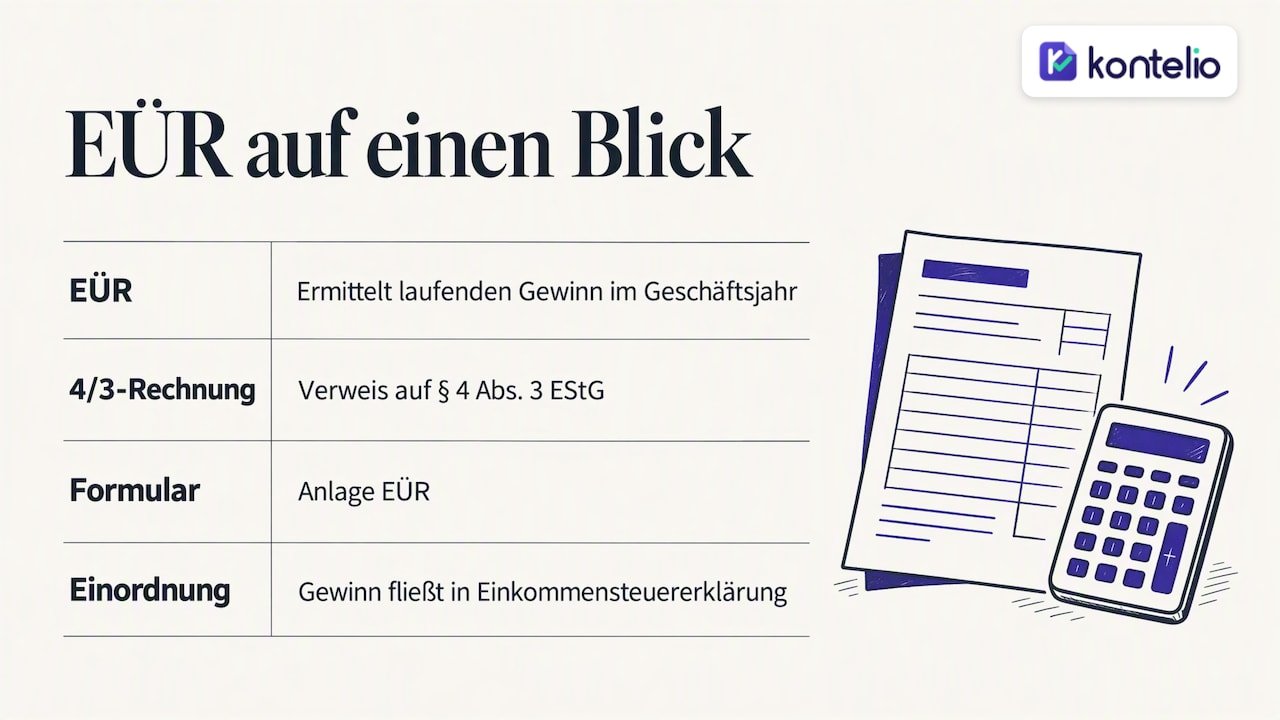
The Einnahmenüberschussrechnung is the simple form of profit calculation. According to IHK Nürnberg, it lets you determine the current profit of a fiscal year and at the same time gives you an overview of your income and expenses. You do not need a Bilanz (balance sheet), an inventory count or doppelte Buchführung (double-entry bookkeeping) for it.
You will often also hear the term “4/3-Rechnung”. It has nothing to do with mathematics; it refers to the legal basis, § 4 Abs. 3 of the Einkommensteuergesetz (Income Tax Act). The official form for it is the Anlage EÜR. It is part of your income tax return: the profit from the EÜR is included there as income from self-employment or from a commercial business. You can read more about which other annexes you need as a self-employed person in our guide to income tax for the self-employed.
Who may prepare an EÜR
This question decides whether you are allowed to calculate so simply at all. According to the Handelskammer Hamburg, Freiberufler and Gewerbetreibende may use the EÜR if they are not required to keep books and do not keep books voluntarily.
EÜR for Freiberufler
For Freiberufler, for example doctors, architects, journalists, translators or IT consultants with a freiberufliche Tätigkeit (independent professional activity), the EÜR is always possible, regardless of how high turnover or profit are. Freiberufler are not merchants within the meaning of the Handelsgesetzbuch (German Commercial Code) and are therefore not required to keep books. Whether your activity is really a liberal profession or already counts as a Gewerbe (trade) is not always clear. You can check this with our guide Freiberufler or Gewerbe.
EÜR for Gewerbetreibende
Gewerbetreibende may use the EÜR until they become required to keep books. According to the Handelskammer Hamburg, the decisive factors include the thresholds of 800,000 euros in turnover and 80,000 euros in profit per year. Anyone who exceeds one of them is asked by the Finanzamt to keep books and must then prepare a balance sheet. Registered merchants and corporations such as the GmbH or UG prepare a balance sheet anyway.
Kleinunternehmer also need an EÜR
The Kleinunternehmerregelung (small-business VAT scheme) exempts you from Umsatzsteuer (VAT), not from calculating your profit. Even with a turnover of just a few thousand euros, you submit an Anlage EÜR every year. You can quickly check whether you stay within the limits under § 19 UStG with the Kleinunternehmer calculator. The rules in detail are in our article on the Kleinunternehmerregelung.
The cash principle
The heart of the EÜR is a simple rule: income and expenses count at the moment they are actually received or paid. What matters is therefore not the invoice date but the day on which the money arrives in or leaves your account.
Three examples make this tangible:
- You write an invoice for 2,000 euros on 15 December, and your customer pays on 8 January. The income belongs to the new year.
- You buy office supplies on invoice in December and pay in January. The expense likewise only counts in the new year.
- You pay for an annual software contract in November. The expense counts in the current year.
You can use this rule to a certain extent, for example by paying for necessary purchases before the end of the year. There are two exceptions you should know: special rules apply to regularly recurring payments around the turn of the year, for example rent or VAT prepayments. And expensive purchases such as a laptop, machine or company car are not deducted in full immediately, but spread over several years through AfA (depreciation for wear and tear). Our guide Preparing the EÜR with AfA shows how AfA works in the EÜR. If you are unsure how to allocate a payment around the turn of the year, ask your tax advisor or your Finanzamt before you send the return.
The documents you need for the EÜR
No Beleg (supporting document), no entry. A guide from the MGP Steuerberater firm lists the documents that need to be gathered for the EÜR:
| Document | What it is for | What to pay attention to |
|---|---|---|
| Outgoing invoices | Proof of your business income | sequential number, all mandatory details |
| Incoming invoices | Proof of your business expenses | issued in your name or your company's name |
| Bank statements | Payment date for the cash principle | mark business payments |
| Cash receipts | Cash expenses, such as postage or office supplies | keep them legible, thermal paper fades |
| Travel expense records | Trips, overnight stays, meals | document the business reason |
| Entertainment receipts | Business meals | state the occasion and participants in full |
Your own invoices must contain the legally mandatory invoice details, otherwise there will be trouble at the latest during an audit. You can find a checklist in the guide Writing invoices as a self-employed person. In business-to-business transactions, the E-Rechnung (e-invoice) is also gradually becoming mandatory. Our overview of the E-Rechnung obligation explains what applies when.
Important: you do not send the documents with your tax return. The Bavarian State Tax Office makes it clear that you only present them if the Finanzamt specifically requests them. You still have to keep them, though: according to tax advisor Michael Schröder, accounting vouchers, invoices and expense receipts must be kept for 8 years, business correspondence for 6 years.
EÜR example: a freelance professional works through her year
The following example is entirely fictitious but shows typical items. Lena is a freelance graphic designer, works from a home office in her flat and does not use the Kleinunternehmerregelung. She therefore settles her VAT with the Finanzamt.
If you are liable for VAT, you treat VAT in the EÜR as a pass-through item that still has an effect: the VAT collected from customers counts as business income, while the Vorsteuer (input VAT) paid and the payments to the Finanzamt count as business expenses. On balance this largely evens out, but it must be shown in full in the Anlage EÜR.
Business income
| Item | Amount |
|---|---|
| Fees from customers, net (received during the year) | €54,000 |
| VAT collected (19 %) | €10,260 |
| VAT refund from the Finanzamt | €0 |
| Total business income | €64,260 |
Business expenses
| Item | Amount |
|---|---|
| Software subscriptions and fonts | €1,900 |
| Depreciation (AfA) of new computer, 1st year | €800 |
| Office supplies and printing | €650 |
| Phone and internet (business share) | €480 |
| Further training | €1,200 |
| Travel costs to customers | €1,150 |
| Professional liability and insurance | €620 |
| Input VAT paid | €1,300 |
| VAT paid to the Finanzamt | €8,700 |
| Total business expenses | €16,800 |
Profit
€64,260 in business income minus €16,800 in business expenses results in a profit of €47,460. Lena transfers this amount to her income tax return.
The example shows three things. First: the computer does not appear with its full purchase price, but only with the depreciation for this year. Second: phone and internet only count with their business share; the private share stays out. Third: an invoice that Lena wrote in December but that was only paid in January is missing from the income and counts in the following year.
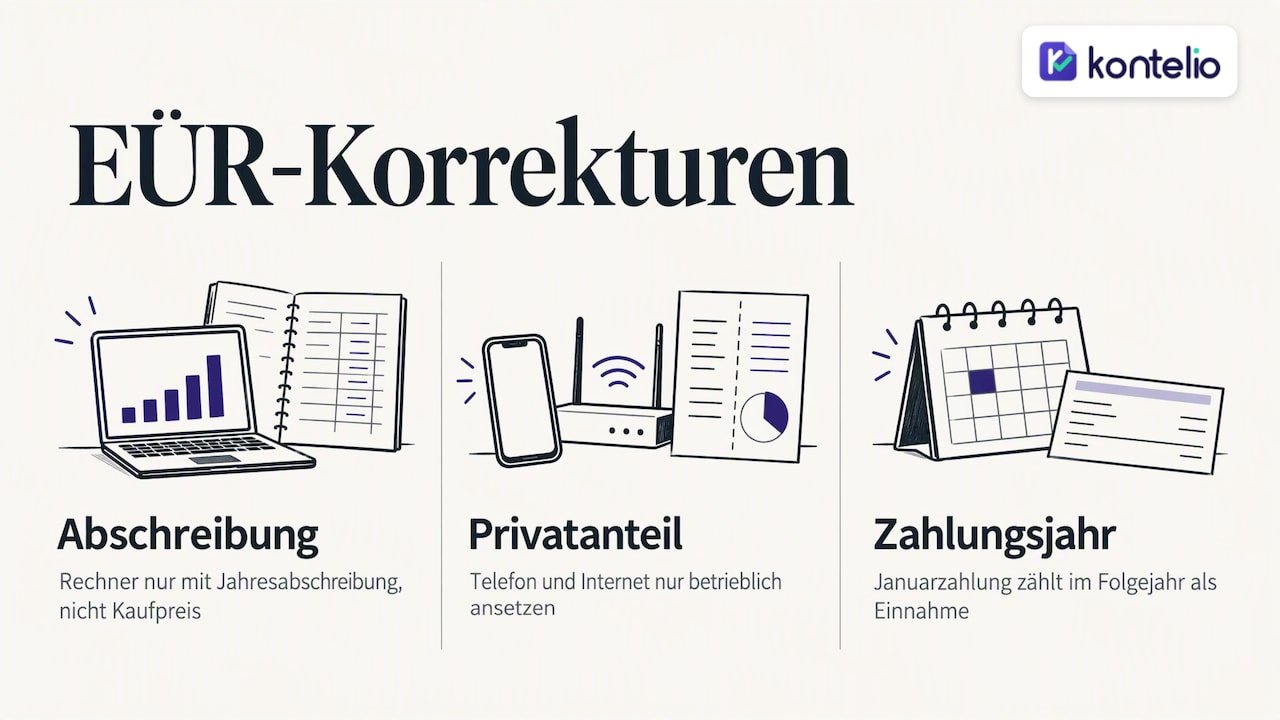
It is precisely these corrections that make the EÜR correct. Tax advisor Michael Schröder stresses that private shares, depreciation and non-deductible expenses are indispensable for a correct profit calculation, even if the basic calculation looks simple. Non-deductible or only partly deductible items include, for example, part of the Bewirtungskosten (business entertainment expenses) and gifts above certain limits. For such items, it is worth taking a quick look at the filling instructions or asking your tax advisor.
Recording withdrawals and contributions correctly
Withdrawals and contributions are flows of money or assets between your private life and your business. If you pay yourself money from your business account to your private account, that is a withdrawal and not a business expense. If you put private money into the business, that is not business income. Neither changes the profit directly.
It is different with the private use of business items: if you drive the company car privately or also use the company phone privately, you must add this private share to your profit. Conversely, a contribution in kind, such as a privately purchased laptop that you will use for work from now on, can be included in the EÜR as business assets. The Anlage EÜR asks about withdrawals and contributions in a separate section.
Anlage EÜR in ELSTER: step by step
The official procedure is described in the ELSTER help on the Anlage EÜR. In practice, you proceed as follows:
- Enter your Steuernummer and Finanzamt. If you have a business Steuernummer (tax number), you select your federal state and enter it. Without a number, you select the responsible Finanzamt and enter your address details. Alternatively, you use a saved tax profile.
- Provide general information about the business. Type of activity, Rechtsform (legal form) and whether you are a Kleinunternehmer.
- Enter business income. Taxable income, VAT-exempt income, VAT collected and refunds from the Finanzamt in the respective lines.
- Enter business expenses. Goods and third-party services, depreciation, premises costs, vehicle costs, other expenses, input VAT and VAT paid.
- Record profit adjustments. These include reserves, hidden reserves as well as withdrawals and contributions.
- Check additional annexes. Depending on your case, you need the fixed-asset register (AVEÜR), the Anlage SZ on debt interest or, for agriculture and forestry, the Anlage LuF. For co-entrepreneurships, further special and supplementary statements are added.
- Transmit electronically. The Anlage EÜR is sent to the Finanzamt, authenticated, with all necessary annexes. You submit a separate EÜR for each Betrieb; fields that do not apply to you remain empty.
We explain the individual lines in the guide Filling in the Anlage EÜR.
Deadlines and form of submission
The Anlage EÜR is part of your income tax return and therefore has the same filing deadline. If you prepare your return with a tax advisor, you usually have considerably more time than someone who files themselves. The tax authorities publish the deadlines for each tax year anew every year, so check them with your Finanzamt or on ELSTER. Submitting the Anlage EÜR on paper is generally no longer provided for. If you really cannot transmit electronically, for example due to a lack of technical equipment, contact your Finanzamt directly and apply for an exemption. If you have VAT, there is also the Umsatzsteuererklärung (annual VAT return); more on this in the guide Umsatzsteuererklärung: deadline and final payment.
Excel template or software?
To get started, a spreadsheet is enough for many people. Our free EÜR template for Excel clearly presents income, expenses and profit. It helps you understand how the calculation is structured.
As soon as invoices, receipts and UStVA (periodic advance VAT returns) come in regularly, the spreadsheet becomes a bottleneck: you type figures in twice, have to match payment data yourself and, at the end, transfer everything into ELSTER by hand. Bookkeeping software takes over exactly these steps. Our guide Choosing bookkeeping software shows which criteria matter when choosing.
Your finished EÜR with Kontelio
Kontelio is our bookkeeping software for the self-employed, freelancers and small businesses in Germany. You write invoices and e-invoices in ZUGFeRD or XRechnung format, photograph receipts directly and archive them in a legally compliant way. Your EÜR is generated from your entries, and you send the Anlage EÜR directly to your Finanzamt via the ELSTER integration. The UStVA, annual return and deadline reminders are also included.
You can try Kontelio free of charge for 30 days, without a credit card. Afterwards you choose a plan: Start for €99 per year or €9.90 per month, Business for €199 per year or €22.90 per month, Pro for €299 per year or €32.90 per month. You can find all details on the Prices and plans page, and more about the feature on EÜR software for the self-employed.
Our view of the EÜR
Most mistakes in an EÜR do not happen in December, but in February, June or September: when a receipt stays in a jacket pocket, a payment is not assigned to any customer or the private share of the phone is forgotten. At year-end, such gaps can only be closed with a lot of effort.
That is why we built Kontelio so that the EÜR is created along the way. If you photograph every receipt right away and write every invoice in the software, at year-end you no longer have anything to calculate, only to check and send. The direct ELSTER connection saves you from typing figures into the Anlage EÜR, and the deadline reminders ensure that no advance return gets lost.
It is also important to us that you can keep your books in the language in which you think most confidently. Many founders in Germany do not speak German as their native language. Tax terms such as Vorsteuer or Entnahme are unwieldy enough in German. A multilingual interface makes the EÜR understandable for them without losing anything of German tax law.
Paulo
Frequently asked questions about the EÜR
Do I have to submit an EÜR if I had no income?
Yes, if you have registered a business, you also submit an Anlage EÜR in a year without income. Expenses such as insurance or software subscriptions then lead to a loss. This loss can be offset against other income.
Do I have to send supporting documents to the Finanzamt with the EÜR?
No. You only submit documents if the Finanzamt expressly requests them. However, you keep them in an orderly manner, invoices and accounting vouchers for 8 years.
What is the difference between the EÜR and a balance sheet?
The EÜR only compares income and expenses by the time of payment. A balance sheet records receivables, liabilities and all assets on the reporting date and requires double-entry bookkeeping. Freiberufler and Gewerbetreibende who are not required to keep books can manage with the EÜR.
Do I need a tax advisor for the EÜR?
No, you may prepare the EÜR yourself and submit it via ELSTER. In complicated cases, for example a company car, real estate in business assets or several businesses, advice is worthwhile. Many self-employed people handle their ongoing bookkeeping themselves with software and only seek advice on individual questions.
How many EÜRs do I submit if I have two activities?
A separate one for each Betrieb. If, for example, you are a freelance copywriter and also run an online shop as a Gewerbe, you prepare two Anlagen EÜR. You leave fields that do not apply empty in each case.
Sources
- Handelskammer Hamburg: Einnahmenüberschussrechnung (EÜR)
- IHK Nürnberg: Profit calculation using the Einnahmen-Überschuss-Rechnung
- ELSTER: Help on the Anlage EÜR
- Tax offices in Bavaria: Changes to the tax return
- Tax advisor Michael Schröder: Einnahmenüberschussrechnung
- MGP Steuerberater: Guide to preparing bookkeeping documents
Recommendations
This article was machine-translated from German. Only the German version is authoritative.