 Black Deal 50% off the first year with annual billing – only until December 31, 2026.

Booking Currency Differences: Exchange Rate, Accounts and Entries

If the exchange rate changes between invoice and payment, you book the difference as an exchange gain or exchange loss to a separate income statement account. The original invoice amount in euros, the Umsatzsteuer (VAT) and the Vorsteuer (input VAT) remain unchanged. If you prepare a balance sheet, you additionally revalue open foreign currency receivables and payables at year-end, at the Devisenkassamittelkurs (mean spot exchange rate) on the balance sheet date. Here you can see which rate applies when, which journal entries you need and which supporting documents you should keep.
In brief
- Recording: You convert a foreign currency invoice into euros at the rate on the day of the transaction and book it with this euro amount.
- Payment: If the euro amount paid or received differs, you book the difference as a currency gain (other operating income) or currency loss (other operating expense).
- VAT: The exchange difference arising on payment does not change the VAT or input VAT of the original invoice.
- Annual financial statements: You value open foreign currency items under § 256a HGB (German Commercial Code) at the mean spot exchange rate on the balance sheet date. For remaining terms of up to one year, this also applies to unrealised gains.
- Evidence: For every converted document, file the rate used, its date and its source.
Table of contents
- Where currency differences come from
- Which rate applies when
- Recording a foreign currency invoice: step by step
- Booking the exchange difference on payment: two examples
- Which accounts to book currency differences to
- Currency differences in the annual financial statements
- What the exchange difference has to do with VAT
- Foreign currency accounts, credit cards and payment services
- Which supporting documents you should keep
- Typical mistakes when booking exchange differences
- Our view on currency differences
- Bookkeeping with Kontovexa
- Frequently asked questions
- Sources
Where currency differences come from
The bookkeeping of a German business is kept in euros. As soon as you issue or receive an invoice in US dollars, Swiss francs or British pounds, you convert the amount into euros. Exchange rates, however, change daily. Between the day you book the invoice and the day the money flows, the rate almost always shifts a little. This gap is called a currency difference or exchange difference.
The specialist literature distinguishes three relevant points in time:
- Occurrence of the transaction: You record the invoice and convert it for the first time.
- Balance sheet date: If the item is still open at year-end, you revalue it.
- Settlement: The payment comes in or goes out, and the actual euro amount is fixed.
This classification gives rise to two types of currency differences. The realised difference arises on payment, because the euro amount in the account differs from the amount booked. The unrealised difference arises on the balance sheet date when you value an open item at the new rate, even though no money has flowed yet. You book the two differently, so it is worth keeping them apart.
Which rate applies when
The most common uncertainty in practice is the question of the correct rate. The answer depends on the point in time and the purpose.
| Point in time | Relevant rate | Basis |
|---|---|---|
| Initial recording of the invoice | Spot exchange rate on the transaction day (bid or ask rate) | DRS 25 |
| Valuation of open items at year-end | Mean spot exchange rate on the balance sheet date | § 256a HGB |
| VAT on the invoice | Monthly conversion rate of the BMF (Federal Ministry of Finance) for the month of supply, or the daily rate on application | § 16 Abs. 6 UStG |
| Payment | Euro amount actually credited or debited according to the bank statement | Bank document |
The German Accounting Standard DRS 25 governs currency translation in consolidated financial statements, but also recommends its rules on foreign currency transactions for single-entity financial statements under commercial law. According to it, the spot rate on the day of the transaction applies to the initial entry. Strictly speaking, you use the ask rate for a payable and the bid rate for a receivable. In practice, small businesses often work uniformly with the ECB euro reference rate published by the Deutsche Bundesbank. What matters is that you apply your method consistently and document it.
Pay attention to the direction of the rate quotation. The euro reference rate is quoted as foreign currency per euro, for example 1.10 US dollars for 1 euro. You then divide the dollar amount by the rate to obtain the euro amount. Anyone who multiplies instead will book a noticeably wrong amount.
Recording a foreign currency invoice: step by step
Before an exchange difference can arise, the invoice must be recorded properly. Here is how to proceed:
- Check the document: Note the invoice date, date of supply, currency, amount in foreign currency and any tax shown.
- Determine the rate: Take the rate for the day of the transaction from an official source and record it.
- Convert: Divide the foreign currency amount by the rate and round to two decimal places.
- Clarify VAT: For services from abroad, such as a software subscription from a US provider, the reverse charge procedure under § 13b UStG often applies. You then owe the VAT yourself and generally deduct it again as input VAT.
- Book: Book the expense or revenue and the payable or receivable with the converted euro amount. Note the foreign currency amount and the rate in the posting text.
The item is now in your books with this euro amount. Everything that happens afterwards due to rate movements is a currency difference.
Booking the exchange difference on payment: two examples
The booking logic for receivables and payables is a mirror image. Two worked examples show the process.
Example 1: incoming invoice in US dollars
You commission an agency in New York, invoice amount USD 10,000. On the invoice date the rate is 1.10 USD per euro.
- Recording: USD 10,000 ÷ 1.10 = €9,090.91 payable
- Payment six weeks later at a rate of 1.15 USD per euro: USD 10,000 ÷ 1.15 = €8,695.65 debited
- Difference: €9,090.91 − €8,695.65 = €395.26 exchange gain
The dollar has weakened, so you pay fewer euros than booked. The journal entry is:
Payable €9,090.91 to Bank €8,695.65 and Currency gain €395.26
Had the dollar strengthened, you would have paid more euros. The entry would then be: Payable and Currency loss to Bank.
Example 2: outgoing invoice in US dollars
You invoice a customer in California for the same USD 10,000, at the same rates.
- Recording: €9,090.91 receivable
- Payment received: €8,695.65 credited to the bank account
- Difference: €395.26 exchange loss
Here the weaker dollar works against you, because you receive fewer euros than booked. The journal entry:
Bank €8,695.65 and Currency loss €395.26 to Receivable €9,090.91
If, on the other hand, the dollar rises, the entry is: Bank to Receivable and Currency gain.
In both examples, the receivable or payable account is fully cleared. That is exactly the purpose of the entry: the open item disappears, and the rate movement ends up as a separate amount in the profit and loss statement. Anyone who simply leaves the difference on the customer or supplier account instead will have small amounts in the open items list at year-end that nobody can allocate anymore.
Which accounts to book currency differences to
Exchange gains and exchange losses belong in the profit and loss statement, namely as other operating income or expenses. The standard charts of accounts provide separate accounts for this. The following split is common:
| Transaction | SKR 03 | SKR 04 |
|---|---|---|
| Expenses from exchange differences / currency translation | 2150 | 6880 |
| Expenses from currency translation (not § 256a HGB) | 2151 | 6881 |
| Income from exchange differences / currency translation | 2660 | 4840 |
| Income from currency translation (not § 256a HGB) | 2661 | 4841 |
The account names differ slightly depending on the version of the chart of accounts. So check the account labels in your own chart of accounts before you create the first entry. The sub-accounts marked “not § 256a HGB” separate translation results that do not stem from the balance sheet date valuation under § 256a HGB. This helps when preparing the notes and when reconciling the commercial and tax balance sheets. If you are unsure which account suits your case, decide on it once with your tax advisor and then always book the same way.
For the EÜR (cash-basis income/expense statement): If you determine your profit with an Einnahmenüberschussrechnung, you generally do not keep receivable and payable accounts. What counts there is what actually flows in or out, i.e. the euro amount on the bank statement. A separate exchange difference entry as in the examples above is then usually not required. For VAT, however, the rate at the time of supply applies here too. It is best to clarify with your tax advisor whether your situation requires special entries.
Currency differences in the annual financial statements
If you prepare a balance sheet, you have to deal with foreign currency items that are still open at year-end. Under § 256a HGB, you translate assets and liabilities denominated in foreign currency at the mean spot exchange rate on the balance sheet date. This mainly concerns monetary items, i.e. cash, receivables and payables. Non-monetary items such as machinery or inventory remain at their historical acquisition cost.
The remaining term is decisive:
- Remaining term of up to one year: The acquisition cost principle and the realisation principle do not apply here. You recognise exchange losses and also unrealised exchange gains in profit or loss.
- Remaining term of more than one year: Here the prudence principle applies. You book exchange losses, but not unrealised exchange gains exceeding the original acquisition cost.
Example: open receivable on 31 December
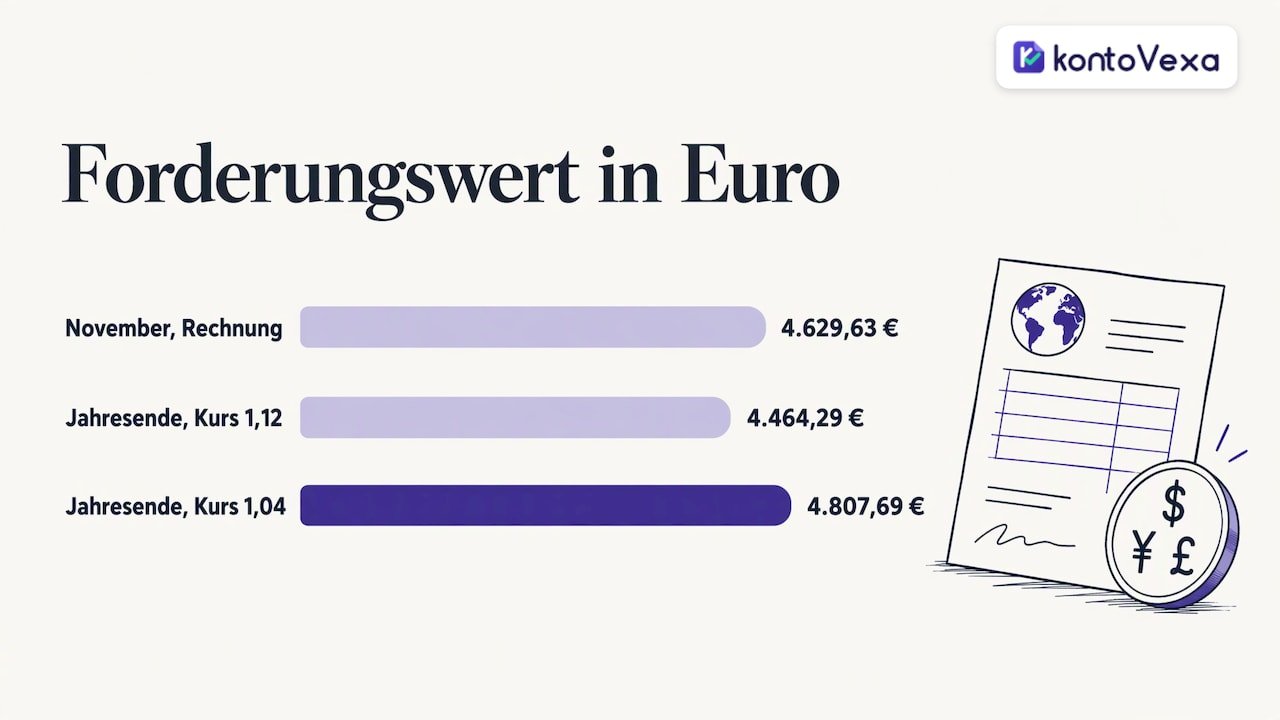
In November you issued an invoice for USD 5,000, converted at 1.08 USD per euro, i.e. €4,629.63. The customer does not pay until February.
- If the mean spot exchange rate on 31 December is 1.12, the receivable is only worth €4,464.29. You book an expense of €165.34: Currency loss to Receivable.
- If it is 1.04, the receivable is worth €4,807.69. Because the remaining term is less than one year, you book the income of €178.06: Receivable to Currency gain.
When the customer pays in February, you compare the payment received with the new book value from 31 December and no longer with the original invoice amount. You again book the difference in the new year as an exchange gain or exchange loss.
The tax balance sheet follows its own rules for valuation above acquisition cost. Especially with unrealised gains and permanent exchange losses, the commercial and tax balance sheets can diverge. Discuss this with your tax advisor before closing the books. Regardless of this, the financial statements themselves remain in euros: § 244 HGB requires the annual financial statements to be in German and in euros, even if you keep current accounts in foreign currency.
Groups with foreign subsidiaries have a further level: they translate entire financial statements. For this, § 308a HGB applies, with the closing rate for the balance sheet, the historical rate for equity and the average rate for the profit and loss statement. The difference appears there in equity as “equity difference from currency translation”. For self-employed people and small businesses, this generally plays no role.
What the exchange difference has to do with VAT
In short: nothing. VAT is calculated at the rate at the time of supply, generally using the monthly conversion rate published by the Federal Ministry of Finance. On application, the Finanzamt (local tax office) may allow the daily rate. If the rate changes by the time of payment, the VAT on your outgoing invoice and the input VAT from your incoming invoice remain unchanged. Exchange gains and exchange losses are not a change in consideration; they are posted to the currency accounts without a tax code.
This has a practical consequence: for the UStVA (periodic advance VAT return), the originally converted amount counts, not the later payment amount. If you work with customers abroad, you should know the basic rules on VAT for the self-employed, because foreign transactions often involve tax exemptions or reverse charge.
Foreign currency accounts, credit cards and payment services
Currency differences do not only arise with invoices. The following cases are also common in everyday business:
- Credit card payment abroad: The card statement usually already shows the euro amount together with the rate. Book the euro amount from the statement and keep the receipt and statement together. The bank's foreign transaction fees are incidental costs of payment transactions, not an exchange difference.
- Foreign currency account, such as a dollar account: The balance is a monetary item. Those who prepare a balance sheet revalue it on the balance sheet date under § 256a HGB. If the euro balance in your books differs from the converted foreign currency balance, you manually transfer the difference to the currency account.
- Payment services with currency exchange: Many services exchange automatically and retain a fee in the process. Separate the exchange fee from the actual rate effect if the statement shows both.
Which supporting documents you should keep
An exchange difference is only as good as its evidence. For every foreign currency transaction, record:
- the original document with the amount in foreign currency, currency, date and description of the service
- the VAT shown or calculated by yourself
- the rate used, with date, source and direction of quotation (foreign currency per euro or euros per foreign currency)
- the bank statement or card statement with the euro amount actually booked
For the annual financial statements, the specialist literature recommends placing an extract of the ECB reference rate from the Bundesbank for the balance sheet date in the closing file. This makes the valuation of every open item traceable even years later, for example during a Betriebsprüfung (tax audit).
Typical mistakes when booking exchange differences
- Correcting VAT retrospectively: The tax stays at the original rate. A correction via the exchange difference distorts the advance return.
- Leaving the difference on the customer account: The open item must be fully cleared, otherwise the open items list grows with tiny amounts.
- Mixing up the rate direction: Dividing instead of multiplying, or vice versa, depending on the rate quotation. A quick plausibility check with rounded figures prevents this.
- Booking bank fees as an exchange loss: Fees belong on the account for incidental costs of payment transactions.
- Forgetting the balance sheet date valuation: Open foreign currency items on 31 December belong on the checklist for the annual financial statements.
- Switching rate sources: Anyone who sometimes uses the bank rate and sometimes the ECB rate can hardly explain their figures. Decide on one source.
Our view on currency differences
At first glance, currency differences seem like a specialist topic for large groups. In practice, they affect more and more self-employed people: the designer with clients in Switzerland, the developer with clients in the USA, the small business that subscribes to software in dollars.
Our experience is that the effort rarely lies in the entry itself. A journal entry for an exchange gain is quickly written. What takes time is finding out which rate was used back then, which document belongs to it and whether the VAT was reported correctly.
That is why at Kontovexa we focus on order from the start: capture documents by photo, archive them in a legally compliant way, manage suppliers and customers properly and submit the UStVA directly via ELSTER (official e-filing portal). Those who work internationally also benefit from the fact that Kontovexa can be used in several languages. This keeps the bookkeeping understandable even when the team does not only speak German.
Paulo
Bookkeeping with Kontovexa
If you regularly work with foreign customers or suppliers, you need bookkeeping in which documents, entries and tax returns fit together. Kontovexa combines invoicing, expense management, document capture with photo upload, E-Rechnungen (e-invoices) in ZUGFeRD and XRechnung formats, the EÜR as well as the UStVA and the Umsatzsteuererklärung (annual VAT return) in one interface. Deadline reminders ensure that no filing slips through, and the ELSTER submission runs directly from the software.

You can test Kontovexa free of charge for 30 days without a credit card. After that, you choose a plan: Start for €9.90 per month or €99 per year, Business for €22.90 per month or €199 per year, Pro for €32.90 per month or €299 per year. You can find all details in our pricing overview.
Frequently asked questions
Where do I book currency differences?
You book exchange gains as other operating income and exchange losses as other operating expenses. The standard charts of accounts have separate accounts for income and expenses from exchange differences. The offsetting entry is made on the receivable, payable or bank account.
How do I book currency differences in SKR 03?
Commonly used are account 2150 for expenses and 2660 for income from exchange differences, plus the sub-accounts 2151 and 2661 for translation results outside § 256a HGB. Check the exact account name in your chart of accounts. In SKR 04, the equivalents are generally 6880 and 4840.
Do I have to book currency differences in the annual financial statements?
If you prepare a balance sheet, you must value open foreign currency receivables and payables at the mean spot exchange rate on the balance sheet date. For a remaining term of up to one year, you also book unrealised gains. If you prepare an EÜR, you generally do not book a balance sheet date valuation, because inflows and outflows are what count there.
Which rate do I use for an invoice in foreign currency?
For the entry, you use the spot rate on the day of the transaction; for VAT, generally the monthly conversion rate of the Federal Ministry of Finance. At year-end, the mean spot exchange rate on the balance sheet date applies to open items. Document the rate, date and source for every document.
Does an exchange difference change the VAT?
No. The VAT and the input VAT remain at the originally converted amount. You book the exchange difference to the currency account without a tax code.
Sources
- DRS 25 Currency translation in consolidated financial statements (DRSC)
- Currency translation in the annual financial statements (Kleeberg)
- Currency translation in the commercial and tax balance sheet (NWB)
Recommendations
This article was machine-translated from German. Only the German version is authoritative.