 Black Deal 50% off the first year with annual billing – only until December 31, 2026.

Uncollectible Receivables: Identify, Write Off, Reclaim VAT

A receivable is uncollectible when, on a sober assessment, you can no longer expect your customer to pay in the foreseeable future. This is the case, for example, when their insolvency petition was rejected for lack of assets, enforcement proceedings came to nothing, or they permanently refuse to pay with concrete reasons. In that case, you write off the gross amount of the receivable and post the net amount as an expense. You reclaim the Umsatzsteuer (VAT) you have already paid through the advance VAT return for the month in which the loss is established. Here we show you step by step how to identify, document and post this properly, with journal entries for SKR 03 and SKR 04 (DATEV standard charts of accounts).
In brief
- Uncollectible means: the receivable cannot be enforced, legally or in practice, for the foreseeable future. You do not have to wait for insolvency proceedings to be completed.
- A receivable is doubtful as long as the loss is merely looming. If you prepare a balance sheet, you then make a specific valuation allowance instead of writing it off.
- Write-off: The gross amount is removed from the customer account, the net amount goes to bad debt losses (SKR 03: 2406, SKR 04: 6936 at 19 %). The automatic account corrects the VAT.
- You correct the VAT under § 17 UStG in the advance return period in which the receivable becomes uncollectible, not retroactively.
- If the customer pays after all, the VAT is corrected again and the receipt is posted as income.
Table of contents
- What makes a receivable uncollectible
- Uncollectible or merely doubtful?
- Writing off uncollectible receivables: step by step
- Correcting the VAT properly
- What the loss means for profit and annual financial statements
- If the customer pays after all
- Making bad debts less frequent
- Our view on bad debts
- Receivables and VAT under control with KontoVexa
- Frequently asked questions
- Sources
What makes a receivable uncollectible
The UStG (VAT Act) does name uncollectibility in § 17 Abs. 2 Nr. 1 as a reason for correcting the taxable base, but does not itself define the term. The definition comes from case law. According to the established case law of the Bundesfinanzhof (BFH, Federal Fiscal Court), a receivable is uncollectible if, on an objective assessment, it is to be expected that you will be unable to enforce your consideration, in whole or in part, at least for the foreseeable future.
This formula contains two points. First, what counts is the objective situation, not your gut feeling. Second, “for the foreseeable future” is enough: the receivable does not have to be lost forever. The BFH bases this on the principle of proportionality: anyone who pays VAT on the basis of agreed consideration should not have to pre-finance it out of their own pocket for a long time while the money is stuck with the customer.
Typical signs in practice
These events generally point clearly to uncollectibility:
- Insolvency petition rejected for lack of assets: There are not even enough assets to pay for the proceedings.
- Opening of insolvency proceedings: From this point on, you can only file your claim with the insolvency administrator.
- Unsuccessful enforcement: The bailiff found nothing that could be seized.
- Debtor's statement of assets (formerly the statutory declaration in lieu of oath) showing no realizable means.
- Unknown whereabouts: The customer has moved, mail is returned, and an address search is unsuccessful.
- Death of the customer with an over-indebted or renounced estate.
- Limitation: The customer invokes the defense of the statute of limitations.
- Substantiated refusal to pay: The customer disputes the basis or amount of the receivable with concrete arguments and therefore does not pay.
An administrative regulation of the State of Brandenburg names a further indicator: a payment delay of two to three times the payment term, but at least more than six months. It dates from 2005 and is not a nationwide law. Nevertheless, the figure is useful as a guideline for your documentation.
Even a solvent customer can leave you with a bad debt
A common misconception: “The customer has money, so the receivable is not uncollectible.” The BFH sees it differently. A substantiated refusal to pay can also lead to uncollectibility; the debtor's ability to pay does not prevent this. If you first had to wait for the end of a lawsuit or insolvency proceedings, you would be worse off than someone whose customer simply has nothing left. So if a customer disputes defects and therefore refuses to pay, the receivable may already be considered uncollectible for VAT purposes during the dispute.
Uncollectible or merely doubtful?
Before you write anything off, the most important question comes first: Is the loss certain, or is it merely looming? The answer determines the entry.
| Feature | Doubtful receivable | Uncollectible receivable |
|---|---|---|
| Situation | Loss is looming but not certain | Enforcement ruled out for the foreseeable future |
| Typical trigger | Several reminders without response, payment difficulties, sluggish installment payments | Insolvency for lack of assets, unsuccessful enforcement, limitation |
| Entry (balance sheet preparers) | Reclassification to “doubtful receivables”, specific valuation allowance on the net amount at the reporting date | Write-off of the gross amount, net amount as bad debt loss |
| VAT | No correction yet | Correction under § 17 UStG |
| Under the EÜR | No entry needed | Only the VAT becomes relevant (see below) |
In short: you value doubtful receivables cautiously, and you write off uncollectible ones. A specific valuation allowance always concerns only the net amount, because you get the VAT back from the Finanzamt (local tax office) in the event of a loss.
Writing off uncollectible receivables: step by step
1. Check and document the loss
Create a file before you post anything. When you correct VAT, the Finanzamt likes to ask why it is being done in that particular month. Helpful documents include:
- the outgoing invoice and, if available, the delivery note or proof of service,
- payment reminder and dunning letters with dates,
- letters from the insolvency court or insolvency administrator,
- the bailiff's report or certificate of non-attachability,
- returned mail, results of an address search,
- emails or letters in which the customer refuses payment, together with their reasoning.
How to word reminders so that they serve as evidence later is shown in our guide to payment reminders and dunning letters.
2. Determine the amount: in full or in part
Not every loss is total. If the insolvency administrator announces a dividend quota or the customer has paid part of the amount, only the remainder is uncollectible. In that case, you write off only that part and correct the VAT proportionally.
3. Posting with an automatic account
The easiest way is to use the automatic accounts for bad debt losses. At 19 % VAT, these are 2406 (SKR 03) and 6936 (SKR 04) in the common DATEV charts of accounts. The software itself splits the gross amount into expense and VAT correction.
Example: You invoiced a GmbH for a service of €1,000 net plus €190 VAT. In March, its insolvency petition is rejected for lack of assets.
| SKR 03 | SKR 04 | Amount | |
|---|---|---|---|
| Debit | 2406 Bad debt losses 19 % VAT | 6936 Bad debt losses 19 % VAT | €1,190.00 |
| Credit | 10000 Debtor GmbH (or 1400) | 10000 Debtor GmbH (or 1200) | €1,190.00 |
Result: €1,000 ends up as an expense in your profit and loss statement, and €190 reduces your VAT liability for March.
4. Posting without an automatic account
If you work with an account without automatic tax handling, you split the amount yourself:
| Debit | Credit | Amount |
|---|---|---|
| 2400 / 6930 Bad debt losses (usual level) | 1400 / 1200 Receivables | €1,000.00 |
| 1776 / 3806 VAT 19 % | 1400 / 1200 Receivables | €190.00 |
For services at 7 %, there are separate accounts for bad debt losses; the logic remains the same. For VAT-exempt transactions, such as intra-community supplies, there is nothing to correct, so the full amount goes to expenses. If you invoiced under the reverse charge procedure, you likewise did not pay any VAT that you could reclaim. The background is explained in our article on the reverse charge procedure.
5. Was the doubtful receivable reclassified first?
If you already carried the receivable as doubtful in the previous year and made a valuation allowance, you now write it off from the doubtful receivables account and release the specific valuation allowance. Only the difference between the value already adjusted and the actual loss then affects your profit.
Correcting the VAT properly
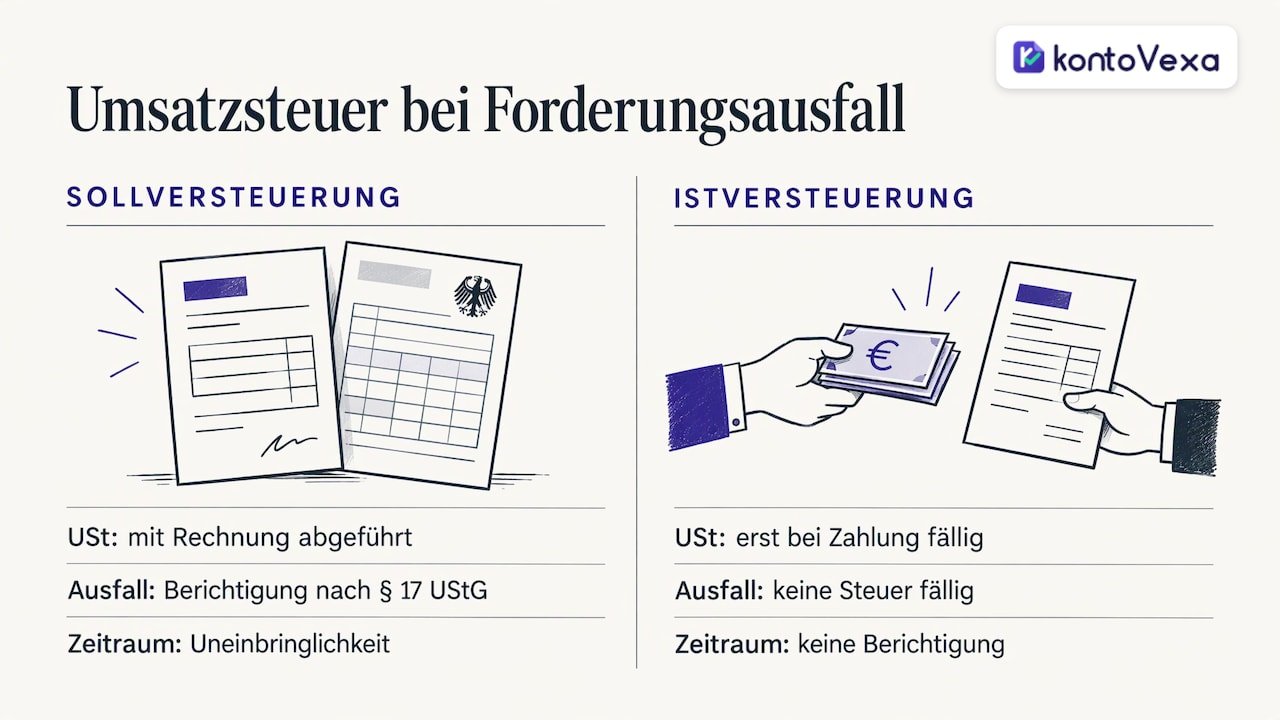
If you pay VAT on your turnover based on agreed consideration (Soll-Versteuerung, accrual-basis VAT), you already paid the VAT to the Finanzamt with the invoice, even though the customer never paid. It is exactly this tax that you reclaim via § 17 UStG.
The timing is fixed: the correction belongs in the tax period in which the uncollectibility occurred. The original advance VAT return (UStVA, periodic advance VAT return) in which you recorded the invoice is not amended retroactively. In the example above, you therefore make the correction in the advance return for March, even if the invoice dates from the previous year. The advance return and the Umsatzsteuererklärung (annual VAT return) have their own lines for reducing the taxable base. Good software fills them in from your entry.
What many people overlook: the correction works both ways. If the consideration is uncollectible, not only does the supplier have to correct their tax, the customer also has to correct their input VAT deduction. You do not have to inform your customer about this; that is a matter for their Finanzamt. You do not issue a cancellation invoice in this case: the service has been provided, only the money is missing. When a cancellation is the right route instead is explained in our guide to cancellation invoices and invoice corrections.
Those using Ist-Versteuerung (cash-basis VAT) have it easier: if you pay VAT based on consideration received, you only owe the VAT when payment arrives. If the customer never pays, no tax ever became due and there is nothing to correct.
If you wrote off a larger receivable in late autumn, check before the annual return whether the correction is in the correct advance return. You can find the relevant deadlines in our article on the Umsatzsteuererklärung and final payment.
What the loss means for profit and annual financial statements
The effects depend on how you determine your profit.
Balance sheet preparers (HGB): With the invoice, you already posted the turnover as income. The write-off offsets this via the expense for bad debt losses; your profit falls by the net amount in the year of the loss. For doubtful receivables, the prudence principle requires a valuation allowance at the balance sheet date so that the balance sheet does not show receivables you realistically will no longer collect. Separate standards apply to valuation allowances in the tax balance sheet. For larger amounts, it is best to consult your tax advisor before making valuation allowances at year-end.
EÜR (Einnahmenüberschussrechnung, cash-basis income/expense statement): Here, only what actually flows counts. An unpaid invoice was never business income, so there is no bad debt loss as a deductible business expense either. Only the VAT is relevant: if, as an accrual-basis VAT payer, you paid the tax, that payment was a deductible business expense, and the refund after the correction is business income. In the end, your profit stays the same, but you have the €190 from the example back in your account. How the Anlage EÜR (official EÜR form) works overall is shown on our page about EÜR software.
If the customer pays after all
This happens more often than you might think: an insolvency administrator pays out a dividend years later, or a customer who had moved away gets in touch and transfers the money. The law anticipates exactly this. If payments are subsequently received on a receivable treated as uncollectible, the tax amount and the input VAT deduction are corrected again, again in the period in which the payment is received.
In practice, you post the receipt as income from written-off receivables (in the DATEV chart of accounts usually 2732 in SKR 03, 4925 in SKR 04) and pay the VAT contained in it again. If the insolvency administrator pays €119 on the receivable from the example, that is €100 income and €19 VAT. For this to work, do not delete written-off receivables from your customer history; instead, mark them as written off.
Making bad debts less frequent
Writing off is the last step. Many bad debts announce themselves earlier, and a few fixed habits noticeably reduce the risk:
- Clear payment terms on every invoice, for example 14 days, and an invoice straight after the service. What an invoice must contain is explained in our guide Writing invoices.
- Partial payments or prepayment for new customers and large orders.
- A fixed dunning routine: a reminder shortly after the due date, a dunning letter after another one to two weeks, then a court payment order or debt collection.
- Check open items weekly, instead of only noticing at the annual financial statements that three customers have owed you money for months.
Our view on bad debts
We see the same pattern among self-employed people again and again: the loss itself is annoying, but it often only becomes expensive because of the bookkeeping. The VAT sits with the Finanzamt for years because nobody initiated the correction. Or the documents proving the loss can no longer be found at the appointment with the tax advisor.
That is why we consider three things crucial. First: keep an eye on open invoices at all times, so that a late payment does not turn into a forgotten bad debt. Second: all supporting documents in one place, archived in a legally compliant way, from the dunning letter to the insolvency administrator's letter. Third: an advance VAT return that you submit directly via ELSTER (official e-filing portal) without detours, so that the correction lands in the right month.
That is exactly why we built KontoVexa. Invoices, customers, supporting documents and the Umsatzsteuer-Voranmeldung are all in one interface. Deadline reminders make sure no date slips through, and if you prefer to work in another language, you can simply switch the software. Bad debts will always exist. They just should not cost you more money than necessary.
Paulo
Receivables and VAT under control with KontoVexa
With KontoVexa, you write invoices and E-Rechnungen (e-invoices), manage your customers and capture supporting documents by photo. You submit your Umsatzsteuer-Voranmeldung, annual return and EÜR directly via ELSTER. This keeps open items, evidence and the VAT correction after a bad debt in a single system.

You can try KontoVexa free for 30 days, without a credit card. After that, the Start plan costs €9.90 per month or €99 per year. You can compare all plans on our pricing page.
Frequently asked questions
When may I write off a receivable?
As soon as it is objectively clear that you will not receive the money in the foreseeable future. Typical occasions are insolvency for lack of assets, unsuccessful enforcement or a substantiated refusal to pay. The law does not set a fixed minimum waiting period; what matters are the circumstances and your evidence.
Do I have to wait until the end of the insolvency proceedings?
No. According to BFH case law, you do not have to wait for insolvency proceedings or a lawsuit to be concluded. In practice, the opening of insolvency proceedings is already one of the most common occasions for correcting the VAT.
Can I simply write off a small receivable because sending reminders is not worth it?
Uncollectible means that you cannot enforce the receivable, not that you do not want to. If you voluntarily waive it even though the customer could pay, this is more of a subsequent discount. It is best to clarify the VAT consequences with your tax advisor. So at least send reminders in a verifiable way before you write off a receivable.
Do I need a VAT correction as a Kleinunternehmer (small business under the Kleinunternehmerregelung)?
No. As a Kleinunternehmer, you do not show or pay any VAT, so there is nothing to correct in the event of a bad debt. In the EÜR, the unpaid invoice never counted as income anyway.
Sources
- NWB database: Uncollectibility of receivables
- Bundesfinanzhof: Decision on uncollectibility (2019)
- Bundesfinanzhof: Decision on refusal to pay (2012)
- State of Brandenburg: Administrative regulation on uncollectibility and § 17 UStG
Recommendations
This article was machine-translated from German. Only the German version is authoritative.